When the plumbing came first.
A 180-person Southern African aviation group, two divisions, thirteen regulatory jurisdictions. The team did not need an AI strategy. They needed an ERP first, and the courage to pause for it.
The situation
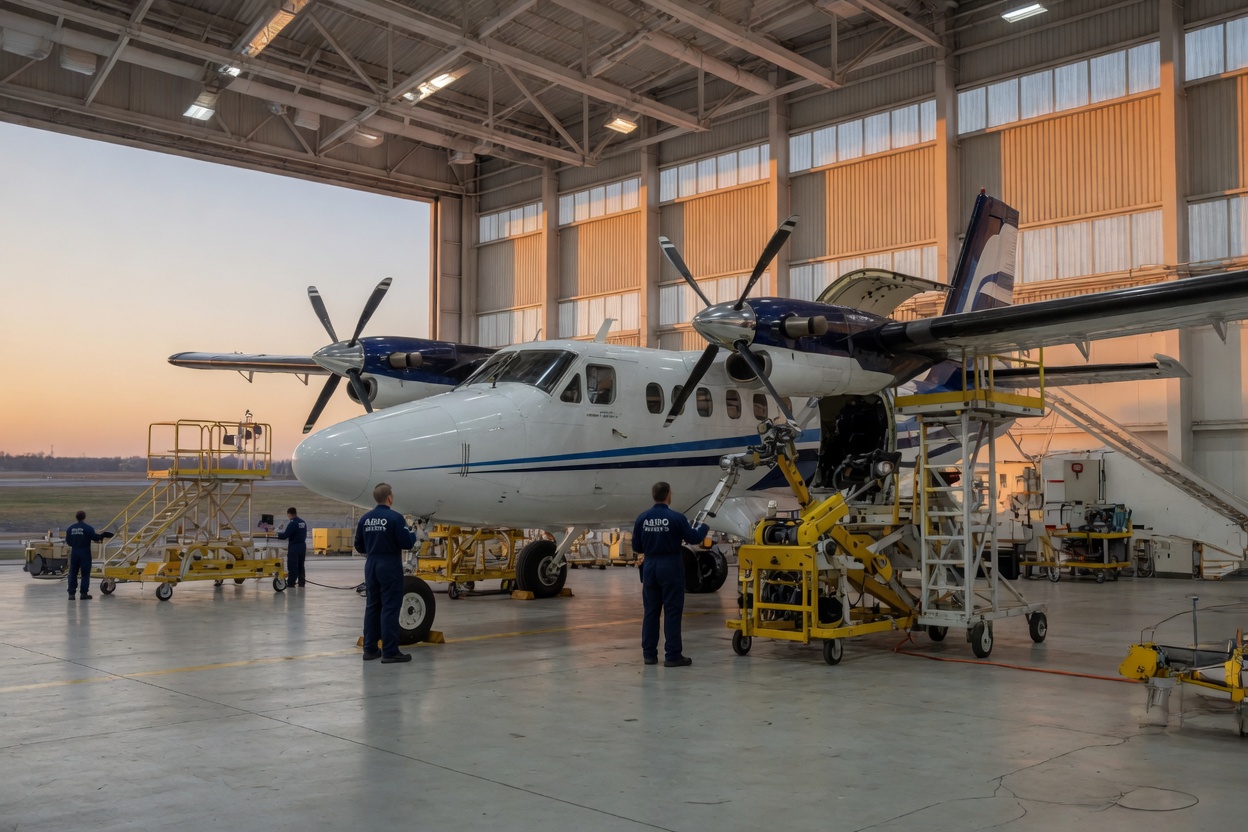
This is a leading aviation group across Southern Africa and Europe, operating an SACAA Part 145-approved MRO division alongside a parts distribution business representing Cessna, Beechcraft, and Pipistrel. Profitable. Reputable. Growing.
And like most growing businesses, the operational infrastructure had not kept up.
The complication
The MRO division ran its work on a legacy platform. The parts division ran its sales on Sage Evolution. Schedules across both lived on a physical whiteboard, paired with manual Excel. Compliance across thirteen jurisdictions was tracked, in places, by one person's diary.
Over 80% of parts sales quotes were going out without ever touching the core system. The data silos were structural. The pricing was inconsistent. The leadership team estimated R32 million a month was leaking through that single gap.
950+ hours a month were going into manual administration. A single physical whiteboard was the only source of truth for aircraft scheduling. The plumbing was the problem.
The question
The team had been told, more than once, that AI was the answer. We took a different view. The honest call was that no AI deployment would survive on top of the systems they had. The work had to start a layer below.
The answer
We applied the A.I.D.E. Framework, but the assessment phase did most of the lifting. Four weeks. Twenty-five-plus stakeholder interviews across both divisions. Then a facilitated workshop, separate sessions per division and a combined session for the cross-divisional dependencies, to surface what the org chart could not.
What we delivered
- End-to-end workflow maps for both divisions, capturing the work as it actually ran (not as it was supposed to run)
- A comprehensive ERP/MRO RFP with detailed requirements documentation, prioritised Must / Should / Could / Won't
- Three-vendor evaluation per division, scored honestly, with the working assumption that we would recommend the right tool, not the loudest one
- A vendor comparison report and a single recommendation: Pentagon2000 as the integrated platform for both divisions
- A roadmap for Phase 2: integration of the Sovereign Intelligence Engine on top of Pentagon2000, once the foundation was in place
What we deliberately did not do
We did not deploy AI on top of the legacy stack. We did not promise that an LLM would solve the quoting problem. The leadership team needed to hear, first, that the underlying tech could not carry what they wanted to put on it. So we paused the AI roadmap to do the harder, less glamorous work first.
Outcomes
The vendor selection alone moved the numbers materially. The full impact lands as Pentagon2000 deploys.
- Parts division: 12,368 hours of annual savings projected, R1.975M+ in annual cost reduction
- Maintenance division: R800K to R1.5M in annual efficiency gains
- Compliance risk reduction across thirteen jurisdictions: 70 to 90%
- Quote turnaround target: 3 days to hours
- Aircraft downtime reduction target: 30 to 50%
- Pentagon2000 vendor score: 8.6/10 (parts), 8.4/10 (maintenance); nearest competitor 7.6/10
- Organisation positioned for 50 to 70% growth without proportional headcount increase
What made this work
The leadership team had the courage to pause the thing they had been told to do (deploy AI) for the thing they actually needed to do first (replace the operating system). That choice was the engagement. Everything else was execution.
Phase 2 is the integration of the Sovereign Intelligence Engine into the Pentagon2000 environment, once the new platform is live. AI-assisted quote generation. Automated regulatory monitoring. OCR for COC, customs, and compliance documents. Demand forecasting against historical patterns. The platform that was always going to come; just not before the foundation could carry it.
Sound like a wrestle you recognise?
The first conversation is a discovery call. We will tell you honestly whether we can help, and what the first step would look like.