
From perpetual heroism to systemic capacity.
A 3,400-person UK technology services group, preparing for a strategic transaction. The People function was getting through on heroism alone. We attacked the highest-volume manual work first.
The situation
This client serves regulated industries: government, financial services, healthcare, defence. The work is exacting. The People function (twenty-five plus staff supporting 3,400 employees across four geographies) had spent five years getting it done.
The way they had been getting it done was the problem.
The complication
Sixteen disconnected HR systems. No single source of truth. A 200-employee discrepancy between Bamboo HR and Power BI nobody could close. Monthly attrition reporting required three days of manual reconciliation.
11,000 IRIS support tickets a year, half of them repetitive, all of them triaged by hand. 1,000 new hires a year, each requiring eight-to-ten manual data actions across systems that did not talk to each other. Sickness absence tracked manually via email-to-Excel, with a 40% return-to-work compliance rate that carried real legal exposure. Sixty-to-eighty open employee relations cases tracked in a SharePoint spreadsheet with no automated deadline tracking.
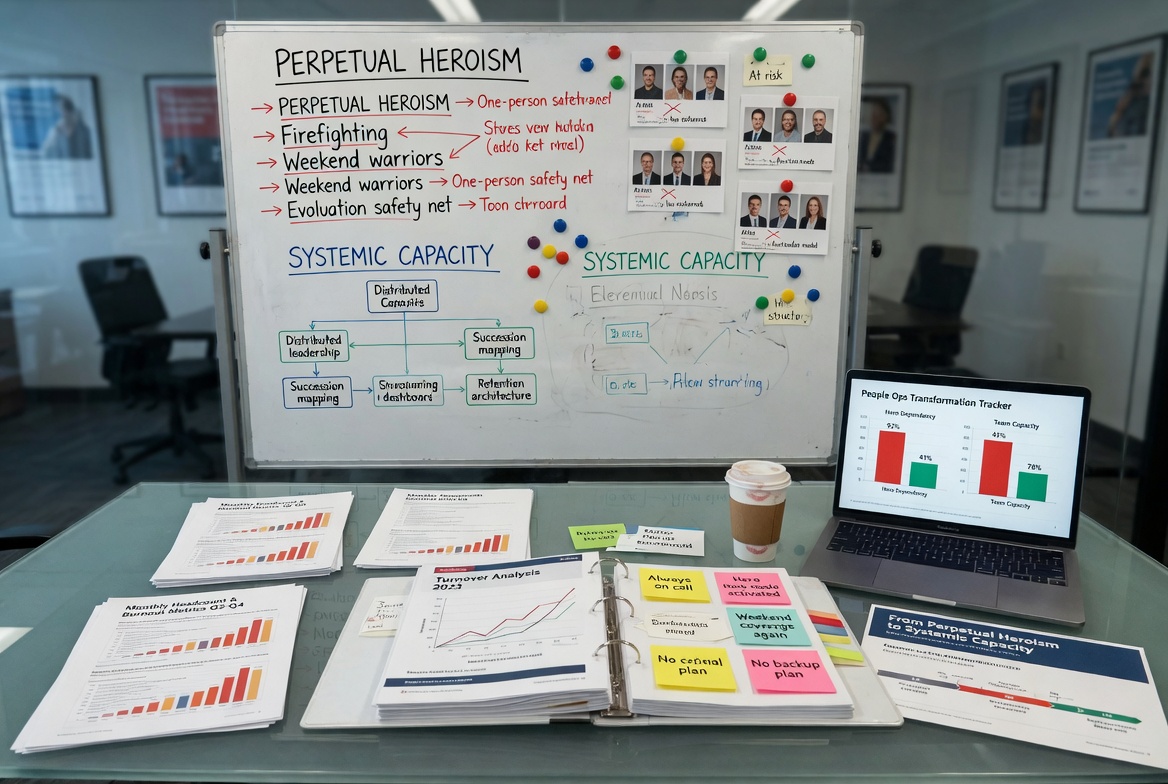
The Chief People Officer described it as "perpetual heroism." Her team was getting through on effort, not infrastructure. And a strategic transaction was coming inside eighteen-to-twenty-four months. Due diligence on this data, in this state, would surface every gap.
The question
The temptation, in a stack this complicated, is to redesign the whole thing. We did the opposite. We picked the highest-volume manual tasks, the ones that were costing the team the most hours, and started there.
The answer
The work was sequenced into two phases: a Friction Audit to clear the bottlenecks, and a Capacity Dividend to reinvest the recovered hours into higher-value work.
Phase 1: Friction Audit (90 days)
- IRIS AI chatbot deployed, RAG-based, for self-service routine queries; NLP auto-triage on the rest
- "API glue" data integration layer between Bamboo HR and Kantata, resolving the 200-employee discrepancy
- Sickness absence workflow automated end-to-end: email capture, system update, return-to-work reminders
- Onboarding data flow automated: Smart Recruiters to IRIS, via API and RPA
- OCR layer for contract data extraction from DocuSign PDFs, auto-populated into Bamboo HR
Phase 2: Capacity Dividend (months 3 to 6, in progress)
- Performance cycle transcription and summarisation, augmented
- Employee relations case management intelligence, replacing the SharePoint spreadsheet
- Proactive workforce planning ("Virtual Bench") for the upcoming transaction
Outcomes
Phase 1 numbers, with Phase 2 still landing.
- 1,800+ hours annually reclaimed in Phase 1
- Ticket volume reduced 35%; remaining tickets auto-triaged with 88% routing accuracy
- Employee data discrepancy resolved from 200 to fewer than 15 exceptions
- Monthly attrition reporting: from 3 days of reconciliation to same-day automated output
- Sickness absence admin reduced 45%; return-to-work compliance from 40% to 72%
- Manual transcription time reduced 40%; data entry errors on new hires reduced 55%
- Contract data extraction time reduced 60%; first-pass accuracy improved to 94%
- Pay review cycle compressed from 12 days to 5 days
- Due diligence readiness: employee data trustworthy for the upcoming transaction
For the first time, my team believes that things are going to get better, not just busier.— Chief People Officer
Sound like a wrestle you recognise?
The first conversation is a discovery call. We will tell you honestly whether we can help, and what the first step would look like.