
Efficiency, not headlines.
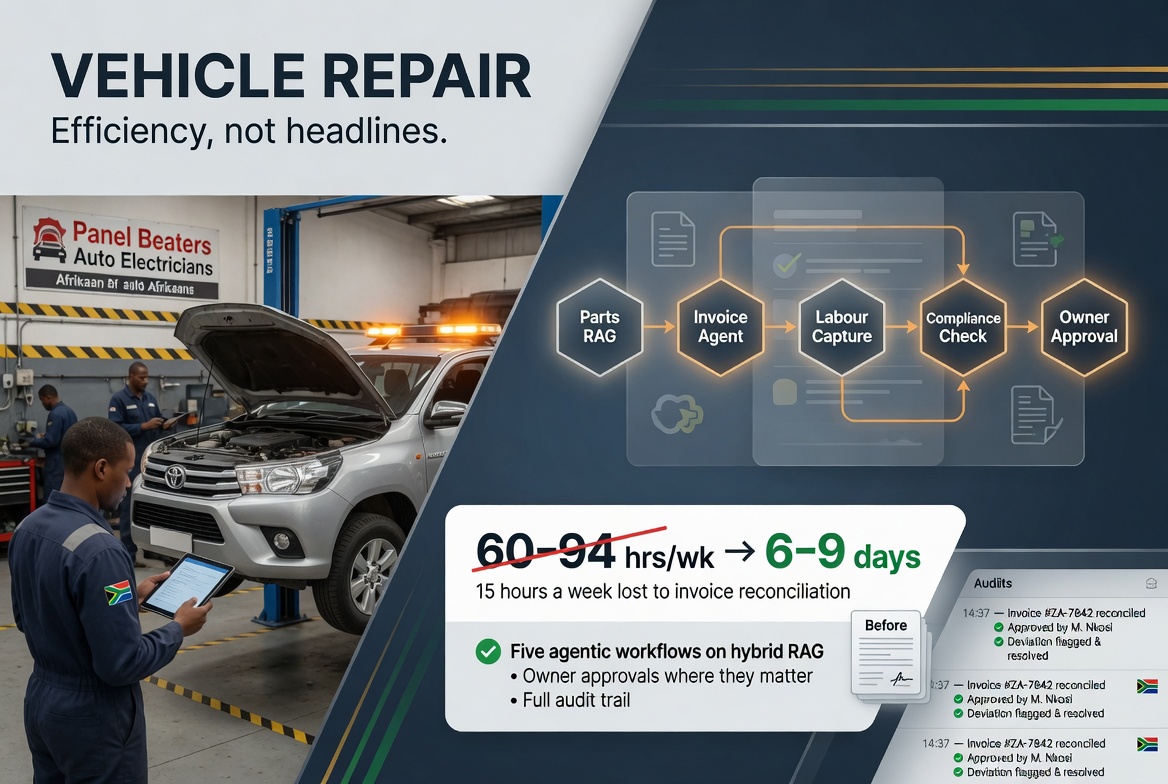
A South African aftermarket vehicle repair business, ~35 staff, thousands of insurance claims a year, forty-plus parts suppliers. The owner did not want a revolution. He wanted his fifteen hours a week back.
The situation
The business was profitable, operationally mature, and serving real customer demand. The systems underneath were a different story.
The complication
Invoice reconciliation alone was costing fifteen hours a week. Supplier invoices arrived by email and PDF, were manually cross-referenced against the legacy TMS and against Sage entries, and an eleven-day cycle from invoice receipt to payment.
Insurance "water deck" approvals were sitting in the owner's spreadsheet for forty-eight-plus hours, with no escalation path. Parts sourcing meant technicians flipping through six-plus OEM catalogues and disconnected price lists, two to three days per parts specification. The compliance calendar lived in one person's head and one person's phone calendar.
QC failure rate was 40%. Most of the variance was being detected after the fact, at month-end, when it was too late to do anything about it.
The question
The owner was clear with us in the first call. "We need efficiency, not headlines."
The answer
We built a hybrid RAG data layer that ingested supplier catalogues, insurance rates, compliance docs, and 18 months of TMS, Sage, and email data. PII scrubbing on-premise. Then we deployed five specialised agentic workflows on top.
- Insurance Approval Tracker. OCR parses water deck emails, auto-logs in TMS, escalates if approval is open more than 24 hours.
- Invoice Reconciliation Agent. OCR extracts supplier invoices, auto-matches against TMS and Sage, flags discrepancies for owner review.
- Parts Specification Assistant. Vector DB search across 6+ OEM catalogues and historical orders, generates parts lists with current pricing.
- Compliance Calendar Monitor. Centralised tracking with escalating reminders at 60, 30, 7, and 24 days before each deadline.
- Cost Variance Detector. Compares insurance-approved against actual invoices in real-time. The variance now shows up immediately, not at month-end.
Proportionate governance
Human approvals for material decisions. Automated with review for extraction and suggestions. Full audit trail throughout. The owner stayed in the loop on everything that mattered, and stayed out of the loop on everything that did not.
Outcomes
Six months in.
- 60 to 94 hours/week of administrative friction reduced
- Invoice processing: 11 days to 3-5 days
- Approval wait time: 48+ hours to under 24 hours
- Parts sourcing: 2-3 days to under 8 hours
- Insurance approval tracker: 4 to 6 hours/week of owner time saved
- Invoice reconciliation: 15 hrs/wk to 3-4 hrs/wk
- Compliance: single-person dependency eliminated; risk HIGH to MODERATE
- Variance detection shifted to real-time (vs. post-hoc month-end discovery)
We needed efficiency, not headlines. They didn't come in saying "AI will revolutionise your business." They came in saying "you're losing 15 hours a week to invoice reconciliation. Here's exactly how to fix it."— Owner
Sound like a wrestle you recognise?
The first conversation is a discovery call. We will tell you honestly whether we can help, and what the first step would look like.